
Académie suisse des sciences naturelles SCNAT
Chemistry Roadmap for Research Infrastructures 2025-2028 by the Swiss Chemistry Community
This community roadmap presents the vision for the future development of chemical sciences in Switzerland. It recommends to set-up or consolidate seven national infrastructures grouped into two pillars of discovery- and challenge-oriented infrastructures, which should foster multinational scientific exchange and collaboration. The roadmap represents the view of the Swiss scientific community in the field of chemistry and is a formal element of the process to elaborate the Swiss Roadmap for Research Infrastructures 2023. This bottom-up contribution to the identification and selection of important national and international research infrastructures has been coordinated by the Swiss Academy of Sciences (SCNAT) on a mandate by the State Secretariat for Education, Research and Innovation (SERI).
Buller R, Copéret C, Emsley L, Gademann K, Hari Y, Merz L (2021)
Chemistry Roadmap for Research Infrastructures 2025–2028 by the Swiss Chemistry Community
Swiss Academies Reports 16 (3).

Académie suisse des sciences humaines et sociales
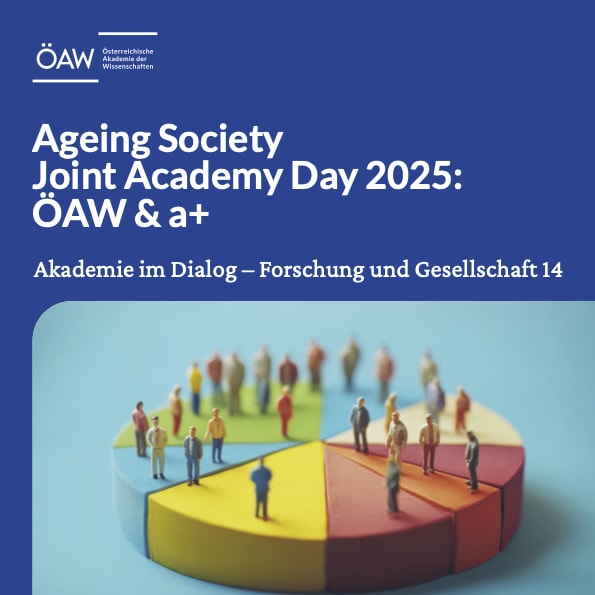
Ageing Society: regards croisés sur une société qui vieillit
Comment penser l’âge et le vieillissement de manière plus différenciée?
La publication consacrée au Joint Academy Day 2025, organisé par l’Académie autrichienne des sciences (ÖAW) avec la participation des Académies suisses des sciences (a+), réunit des perspectives interdisciplinaires sur les dimensions sociales, économiques, culturelles et éthiques du vieillissement.
Les contributions invitent à considérer l’âge et le vieillissement non seulement comme un défi, mais dans toute leur diversité et comme un enjeu pour l’ensemble de la société.
Jeune Académie Suisse JAS

Compassionate Science - Integrating Empathy and Compassion in Research
This report explores how empathy and compassion shape research practices across disciplines. Drawing on a review of existing literature and illustrative examples from early-career researchers, it shows that empathy and compassion are not abstract ideals but practical dimensions of research that can influence study design, relationships, data interpretation, and knowledge translation. Across fields, integrating these dimensions can strengthen trust, deepen understanding, improve collaboration, and enhance ethical reflexivity.
Académies suisses des sciences

Coûts de construction et financement de nouvelles centrales nucléaires en Suisse
Le présent rapport propose une analyse détaillée de l’évolution observée des coûts de construction de nouvelles centrales nucléaires et examine les coûts potentiels d’une éventuelle nouvelle construction en Suisse ainsi que les incertitudes qui y sont liées. Il présente en outre les modèles de financement actuels en Europe ainsi que les risques financiers liés à une telle construction pour l’État et les entreprises privées.